Your Car Payment Is Costing You More Than It Should. Here's How to Fix It.
The dealer's finance office is one of the most profitable rooms in any car dealership. Most buyers walk out not knowing how it works. Here's the full picture, including what to do if you've already signed.
By Morgan Hayes · Updated April 2026
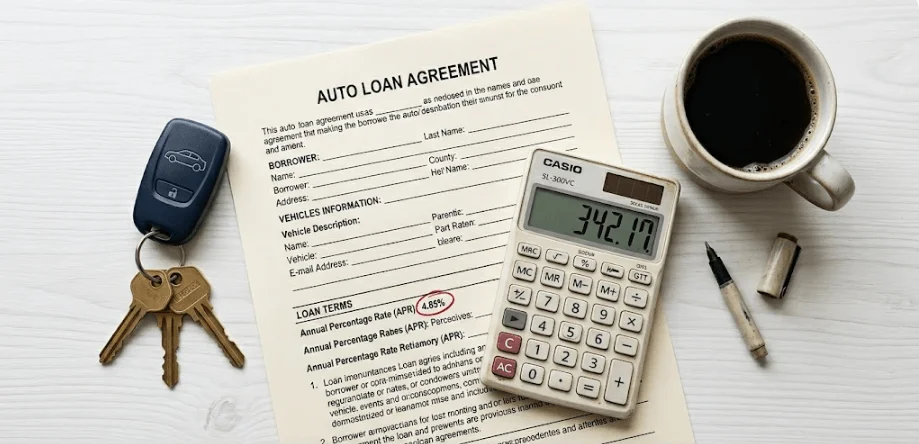
Most people spend weeks researching which car to buy and about twenty minutes in the finance office. That imbalance is not accidental. The finance office is designed to move quickly, with paperwork already prepared, numbers presented with confidence, and a list of products explained in language that assumes you'll say yes.
The result is that a significant portion of what many buyers pay each month has nothing to do with the car. It comes from a rate markup they didn't know was negotiable, add-ons they didn't know were optional, and a loan term that was extended to make a number on a page feel manageable.
None of this is permanent. Below is what's actually happening in that room, a verdict on every product the finance office commonly sells, and a practical guide to fixing your rate if you've already driven off the lot.
Part One
How the Finance Office Actually Makes Money
When a lender approves your loan application, they approve it at a wholesale rate called the buy rate. This is what the bank will accept. The dealer is then legally permitted to present you with a higher rate and keep the difference between what you pay and what the lender charges. This spread is called the dealer reserve or rate markup. It is standard industry practice, it is legal in most states, and it is almost never disclosed.
"The rate you're offered is not the rate the lender approved. The dealer marks it up and keeps the difference."
The markup typically runs between 1 and 3 percentage points. On a $30,000 loan over 60 months, a 2-point markup costs approximately $1,600 in additional interest over the life of the loan. For longer terms or larger balances, the number is higher. Two buyers with identical credit scores financing the same car at the same dealership can leave with different rates depending on the finance manager and how the conversation went.
The second mechanism is the monthly payment question. When a finance manager asks "what payment are you comfortable with?", they're not being helpful. They're setting up a negotiation where the variable they control (the loan term, the rate, the add-ons rolled in) can be adjusted invisibly while the number you're focused on stays the same. A $480 monthly payment on a 72-month loan means something very different at 5% than at 9%.
$30k at 5%
60 months: total cost $33,968
Monthly: $566
$30k at 8%
60 months: total cost $36,498
Monthly: $608
Same loan, same term. A 3-point rate difference costs $2,530 extra over five years.
Bank or credit union
5% APR
Monthly: $566
Total interest: $3,968
Total paid: $33,968
Typical dealer markup
8% APR
Monthly: $608
Total interest: $6,498
Total paid: $36,498
Part Two
Every Finance Office Product, Honestly Evaluated
The finance office typically presents four to six products after the purchase price is agreed. Each is framed as a sensible addition. Most aren't. Here's a straight verdict on each one.
Extended Warranty
Skip ItDealers mark up extended warranties significantly. The same coverage is available directly from the manufacturer or from third-party warranty providers at a fraction of the cost. If you financed a warranty you don't want, most contracts allow cancellation within 30 to 90 days, sometimes longer. Any refund is applied to your loan principal, not your monthly payment.
Exception: If you're buying a used vehicle outside the manufacturer warranty window and have no emergency fund to cover major repairs, a warranty from a reputable third party (not through the dealer) may be worth pricing out separately.
GAP Insurance
It DependsGAP covers the difference between what you owe and what your insurer pays out if the car is totaled. It matters most in the first 12 to 18 months on a long-term loan with little down, when you're most likely to owe more than the car is worth. The product itself is legitimate.
The catch: The dealer charges $600 to $900 for something your own auto insurer sells for $100 to $200 per year. If GAP coverage makes sense for your situation, cancel the dealer version and add it directly to your existing auto policy instead.
Paint and Fabric Protection
Skip ItA dealer-applied sealant that costs $100 to $200 in materials is typically sold for $500 to $1,500. The protection offered is marginal compared to modern factory paint treatments and widely available consumer-grade ceramic coatings. This is among the highest-margin products in the finance office and among the lowest-value ones for the buyer.
Tire and Wheel Coverage
Skip ItCovers tire replacement and rim damage from road hazards. In most markets the annual cost exceeds what you'd realistically pay out of pocket for the covered events. Many credit cards include roadside assistance that partially overlaps with this coverage. Worth skipping for most buyers, particularly those not driving in areas with severe road conditions.
Credit Life and Disability Insurance
Skip ItPays off or covers your loan if you die or become disabled. The premise sounds reasonable. The execution is poor: premiums are high, coverage is narrow, and it only covers the loan balance rather than your broader financial situation. A standalone term life policy covers far more at a lower cost. This is the easiest no in the finance office.
Manufacturer Financing (Promotional Rates)
Worth ItAutomakers periodically offer promotional rates through their own financing arms, sometimes as low as 0% to 2.99%, on specific new or current-model-year vehicles. These rates are typically below anything a bank or credit union can match and are one of the few scenarios where dealer-arranged financing is the right choice.
Important: These offers apply to new vehicles and specific models only, often at end of model year. Check the manufacturer's current financing page before your visit. Promotional rates also sometimes require forgoing a cash rebate, so run both scenarios before deciding.
Worth checking
Your car loan is not the only place you're overpaying.
Most drivers who switch insurers save between $400 and $800 per year. The comparison takes about two minutes and does not require talking to anyone.
7 ways to cut your car insurance bill this year arrow_forwardPart Three
If You've Already Signed: How to Fix the Rate
Refinancing replaces your existing loan with a new one at a different rate, term, or both. The process typically takes less than a day online and requires no dealer involvement. Most lenders allow a soft pull to check your rate before you formally apply, meaning you can compare options without any impact to your credit score.
The standard threshold for refinancing to be worth the effort is a rate reduction of at least one full percentage point. Below that, the administrative friction and minor credit impact generally outweigh the saving. Above it, the math almost always works in your favor.
Where to check your rate
Caribou
Refinancing marketplace. Soft pull first, matches you against a network of lenders, clean process. The clearest starting point for most borrowers.
PenFed Credit Union
Open to anyone. Consistently among the lowest auto loan rates available. Membership takes minutes to set up. Worth the extra step for borrowers with 700+ scores.
RefiJet
Specializes in auto refinancing. Faster approvals and broader credit acceptance than most platforms. Worth checking if your score is between 600 and 680.
Your current credit union
If you have a relationship with a local credit union, check their current auto rates first. Many run rate specials that undercut national options. Look for "beat your current rate" promotions, which appear regularly at regional institutions.
The correct sequence if you want to cancel add-ons and refinance:
- 1. Cancel the unwanted add-ons first. The refund reduces your loan principal.
- 2. Wait for the credit to post (typically 2 to 4 weeks).
- 3. Refinance the reduced balance at the lower rate.
Cancelling a warranty alone does not lower your monthly payment. Refinancing alone doesn't recover what you overpaid on add-ons. Both steps together produce the maximum saving.
Common Questions
What People Usually Ask
Can I refinance right after buying?
Yes. Most lenders require one to three months of payment history, but there is no legal waiting period. If you've found a rate that's meaningfully better than what you signed, applying sooner reduces the interest you pay in the meantime.
Does refinancing hurt my credit?
Rate checking uses a soft pull with no impact. The hard inquiry at formal application typically costs 5 to 10 points temporarily. Applying with multiple lenders within a 14 to 45 day window usually counts as a single inquiry. The impact is minor and recovers within a few months.
What credit score do I need?
Most lenders approve refinancing for scores above 600. The best rates require 700 or higher. Credit unions are typically more flexible than banks on both score requirements and pricing. If your score has improved since you took out the original loan, it's worth checking what you now qualify for.
Shorter or longer term when refinancing?
Shorter term means higher monthly payment but less total interest. Longer term lowers your payment but costs more over time. If the goal is reducing total cost, take the shortest term your budget can handle. If you need monthly relief, a longer term at a lower rate still saves real money compared to your current loan.
Can you cancel dealer add-ons after signing?
Many can. Extended warranties, dealer-sold GAP insurance, and protection packages are frequently cancellable within 30 to 90 days, sometimes longer. The refund is prorated and applied to your loan principal. Call the finance office, ask for the cancellation terms on each product, and get the process in writing.
The Bottom Line
The Finance Office Counted on You Not Knowing. Now You Do.
The markup is legal. The add-ons are optional. The monthly payment framing is a distraction. None of this is disclosed because disclosure would cost the dealership money.
If you haven't signed yet: get a pre-approval from a credit union before you walk in, focus on out-the-door price not monthly payment, and say no to everything in the finance office except possibly GAP if you're putting little money down.
If you've already signed: call about cancelling any add-ons you didn't need, wait for those credits to post, then check your refinancing options. The process takes an afternoon. The saving typically runs into the thousands.
Also worth reading: 7 Ways to Cut Your Car Insurance Bill This Year arrow_forward